
June 25, 2026
Key Takeaways
Hoisting and rigging operations are at the center of some of the most high-stakes work in heavy industry — and when something goes wrong, the consequences are severe. A dropped load, a snapped sling, or a crane contacting an overhead powerline can mean lost equipment, lost time, and lost lives.
With approximately 125,000 cranes operating across the United States, and electrocution accounting for roughly 1 in 10 construction deaths, the risks are not theoretical. They happen on real job sites, often because of small, preventable errors — a miscalculated load weight, a worn sling that wasn’t pulled from service, or a sling angle that was off by just a few degrees.
This guide covers everything you need to know to execute lifting operations safely and efficiently — from load calculations and equipment selection to inspection protocols and legal compliance.
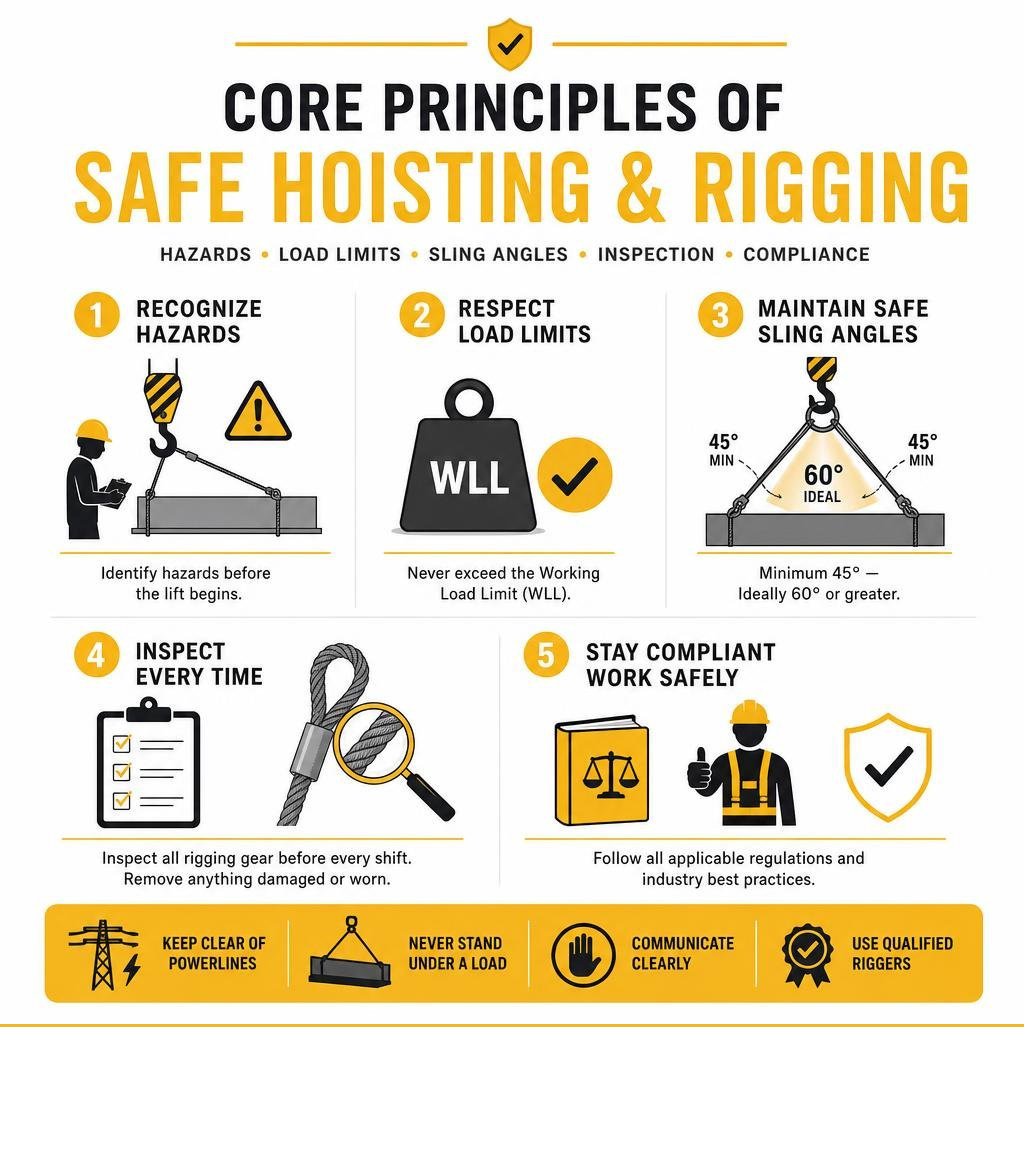
At a glance — what safe hoisting and rigging requires:
- Know your load weight before any lift begins
- Inspect all rigging gear before every shift — no exceptions
- Maintain safe sling angles (minimum 45°, ideally 60° or greater)
- Never exceed the Working Load Limit (WLL) of any component
- Keep loads away from powerlines — maintain required safe distances
- Use qualified riggers — rigging is a skilled trade, not a task to improvise
Relevant articles related to hoisting and rigging:
- Safety First: Prioritizing accident-free execution and strict adherence to OSHA standards.
- Accurate Calculations: Why precise load weight and sling angle calculations are non-negotiable.
- Equipment Selection: Choosing the right slings and hardware to prevent failure.
- Rigorous Inspections: Implementing pre-shift inspection protocols for all rigging gear.
- Professional Execution: How partnering with experienced riggers minimizes operational downtime.
What Are the Primary Hazards in Hoisting and Rigging?
Lifting several tons of machinery inside an active manufacturing plant leaves zero margin for error. Understanding the primary hazards on-site is the first step toward mitigating risk and keeping projects on schedule.
- Electrocution: Contact with overhead powerlines remains one of the leading causes of fatalities during crane operations. Riggers and operators must maintain strict clearance distances based on line voltage (typically a minimum of 10 feet for lines up to 50kV, and more for higher voltages).
- Crane Tipping: This is almost always caused by poor ground conditions, improper outrigger configuration, or lifting a load that exceeds the crane’s rated capacity for its boom angle.
- Dropped Loads: Unsecured materials, incorrect hitch configurations, or component failures can cause loads to slip or fall.
- Severe Weather: High winds can turn a large, flat load into a sail, causing it to swing violently out of control even if the weight is well within the crane’s limits.
To establish a baseline safety protocol before hook-up, refer to this practical A Quick Start Guide to Safe Rigging and Lifting.
How to Calculate Load Weight and Working Load Limits (WLL)
You should never guess the weight of a load. An underestimated load can snap rigging hardware or tip a crane in seconds. Riggers determine weight using shipping documents, manufacturer specifications, or direct material calculations.
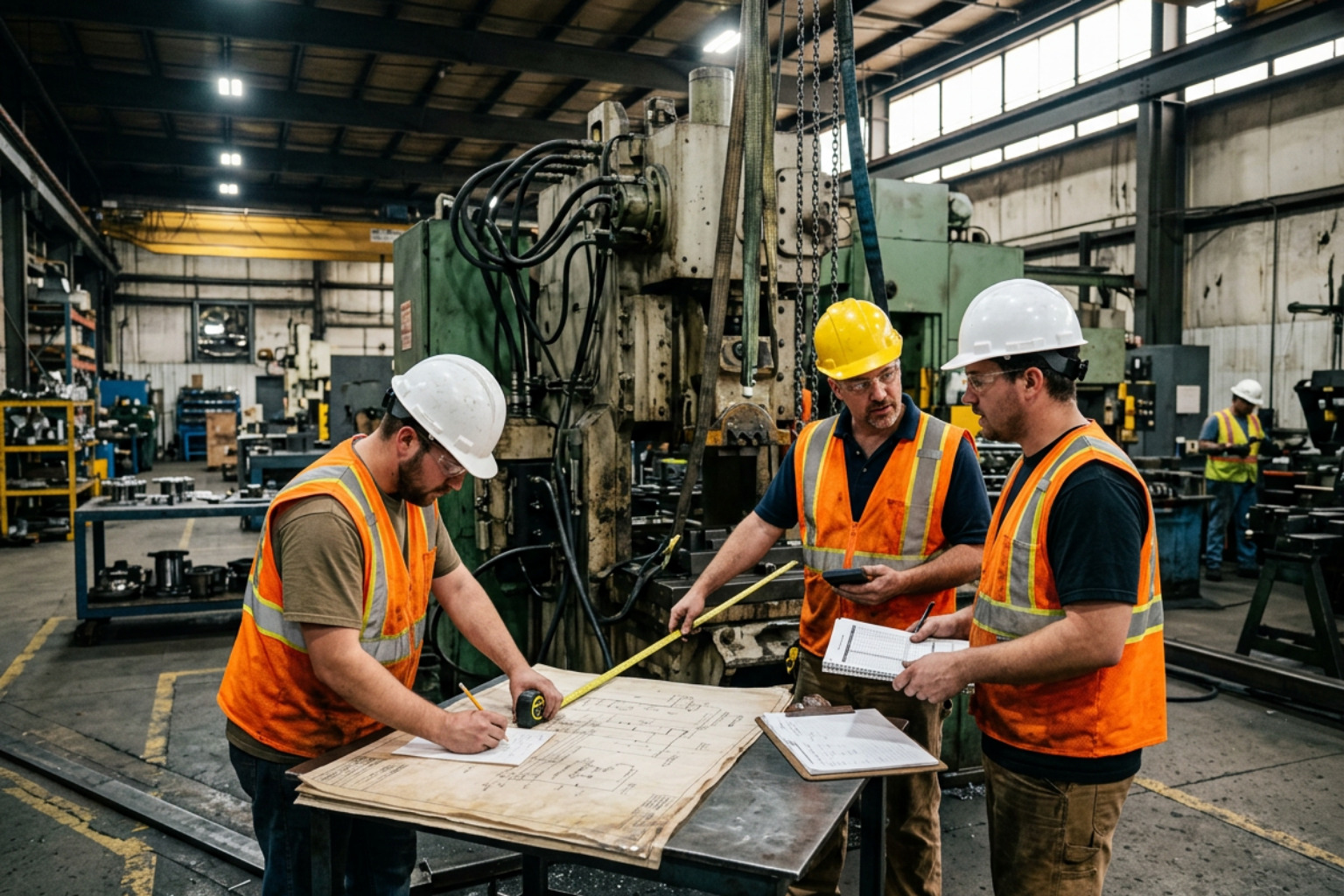
When documentation is unavailable, you must calculate the weight based on material volume and density:
- Steel: Weighs approximately 490 lbs per cubic foot (or a standard rule of thumb: 40 lbs per square foot per inch of thickness).
- Spruce Lumber: Weighs approximately 28 lbs per cubic foot.
- Ice: Weighs approximately 56 lbs per cubic foot (crucial for outdoor storage yards in New England winters).
For example, a solid steel plate measuring 1.5 inches thick, 3 feet wide, and 6 feet long is calculated as:
3 ft x 6 ft = 18 sq ft
18 sq ft x 1.5 inches = 27
27 x 40 lbs = 1,080 lbs per plate
Every piece of rigging hardware – from shackles to master links – is stamped with a Working Load Limit (WLL). The total weight of the load, plus the weight of the rigging hardware itself, must never exceed the WLL of the weakest component in the assembly. For a deeper look at managing complex moves, read Everything You Need to Know About Industrial Rigging and Moving.
Sling Angle Calculations in Hoisting and Rigging
As the angle between the sling leg and the horizontal plane decreases, the tension on each leg increases dramatically. This is one of the most critical concepts in hoisting and rigging.
- At a 90-degree angle (vertical lift), each leg of a two-leg sling carries exactly 50% of the load.
- At a 30-degree angle, the tension on each leg spikes to 100% of the total load weight.
- A tiny 5-degree error in measuring a shallow 15-degree sling angle can result in a massive 50% error in the assumed load per leg.
Because of this rapid tension increase, keeping sling angles above 45 degrees is mandatory, and angles above 60 degrees are highly recommended. For specialty lifting beams and custom setups, riggers rely on certified below-the-hook design standards to maintain proper geometry and safety margins.
Selecting the Right Equipment: Fibre Ropes, Wire Ropes, and Chain Slings
Choosing the correct sling type depends entirely on the load’s weight, shape, temperature, and fragility. Using the wrong material can destroy both the load and the rigging.
| Sling Type | Key Advantages | Disadvantages / Limitations | Best Use Cases |
|---|---|---|---|
| Synthetic Web Slings (Nylon/Polyester) | Lightweight, flexible, will not scratch finished surfaces. Nylon stretches up to 6% to absorb shock. | Vulnerable to sharp edges, cuts, chemical exposure, and temperatures above 180°F. | Fragile loads, finished machinery, and light-to-medium lifts. |
| Wire Rope Slings (6×19 IWRC) | Excellent strength-to-weight ratio, high fatigue resistance, and good structural stability. | Can kink, crush, or develop broken wires. Easily damaged by sharp corners. | Heavy industrial construction, bulk materials, and outdoor lifts. |
| Alloy Steel Chain Slings (Grade 80/100) | Extremely rugged, highly resistant to abrasion, cuts, and temperatures up to 400°F without capacity loss. | Very heavy, expensive, and can easily mar or damage finished surfaces. | Foundry work, steel mills, and lifting rough, hot, or sharp-edged loads. |
To understand how these different materials are deployed in specialized industrial environments, see our breakdown in What is Rigging Service?.
Pre-Use Inspection Procedures for Rigging Hardware
A professional rigger performs a visual inspection of all rigging hardware before every single shift. If any component shows signs of compromise, it must be immediately cut, destroyed, and discarded to prevent accidental reuse.
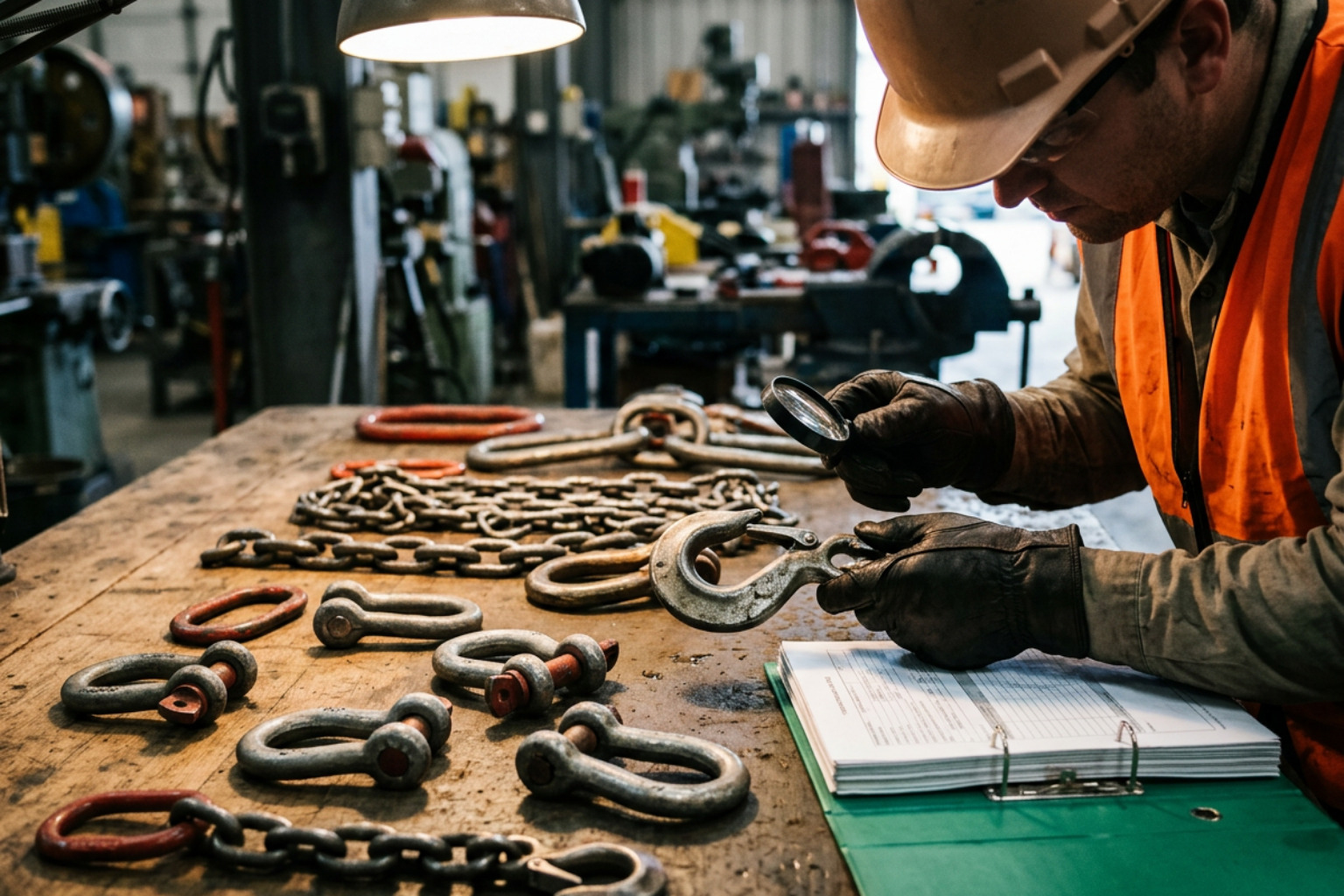
- Wire Rope Slings: Inspect for kinking, crushing, birdcaging, or severe corrosion. Remove from service if there are 10 randomly distributed broken wires in one rope lay, or 5 broken wires in one strand in one lay.
- Synthetic Web Slings: Look for acid or caustic burns, melted fibers, snags, punctures, or broken stitching. Many modern slings feature red warning yarns woven into the inner core; if these red yarns are visible, the sling is dead and must be discarded.
- Alloy Steel Chain Slings: Perform a detailed, link-by-link inspection. Check for bent, cracked, gouged, or stretched links. Ensure each link is stamped with the manufacturer’s grade (usually an ‘A’, ‘8’, or ’10’).
- Rigging Hardware (Shackles, Hooks, Eyebolts): Inspect shackles for body twist, pin wear, or thread damage. Never replace a shackle pin with a standard bolt. Ensure eyebolts are fully threaded and flush with the load surface.
For guidance on vetting your rigging partners and their safety protocols, read How to Choose Industrial Rigging Services.
Step-by-Step Process for Ensuring Load Stability and Control
To execute a stable, controlled lift, a rigging crew must follow a systematic process:
- Locate the Center of Gravity (CG): The crane hook must be positioned directly above the load’s center of gravity. If the hook is off-center, the load will tilt and swing violently when lifted.
- Keep the Hoist Line Plumb: Ensure the hoist line is completely vertical before lifting. Side-loading a crane boom can cause catastrophic structural failure.
- Use Tag Lines: Attach soft fibre tag lines to the load to control rotation and guide it through tight spaces without placing workers’ hands directly on the load.
- Deploy Spreader Beams for Long Loads: For loads exceeding 12 feet, use spreader beams to eliminate the risk of tipping, sliding, or bending.
- Establish Clear Communication: Use a designated, qualified signal person. Standardized hand signals or dedicated, hands-free two-way radios must be used to coordinate moves between the operator and the rigging crew.
When executing complex lifts in congested metropolitan areas, working with experienced regional rigging and logistics specialists ensures compliance with local municipal permits and regional safety standards.
Legal Compliance and Safety Factors
Rigging safety is heavily regulated to protect personnel and property. Standard safety factors (or design factors) represent the ratio of the material’s breaking strength to its allowable working load limit:
- Slings: Must maintain a minimum design factor of 5:1. This safety margin accounts for wear, dynamic shock loading, and minor sling angle deviations.
- Live Crane Hoist Ropes: Require a design factor of 3.5:1.
- Boom Pendants: Require a design factor of 3:1.
In Massachusetts and across New England, operating hoisting machinery requires specific state licensing. Keeping up to date with these rules is essential; you can review the current requirements directly on the Hoisting Licensing and Exams – Mass.gov page.
Regulatory Standards for Hoisting and Rigging Safety
Under federal law, specifically OSHA 1926.753 (which governs steel erection and heavy lifting), all rigging activities must be directed by a qualified rigger.
A qualified rigger is defined as someone who possesses a recognized degree, certificate, or professional standing, and has successfully demonstrated the ability to solve problems related to rigging loads. Additionally, a competent person must perform daily pre-shift inspections of all crane components and ground conditions.
For projects involving complex warehousing, storage, or heavy industrial machinery moves in New England, coordinating with experienced regional riggers is key to ensuring compliance with these strict federal and state laws. Learn more about regional logistics and compliance in Everything About Industrial Rigging and Warehousing in New England.
Common Mistakes in Rigging Operations
Even experienced crews can fall into dangerous habits. Here are the most common mistakes that lead to near-misses and structural failures on-site:
- Improper Weight Calculations: Relying on guesswork instead of verified scale tickets, blueprints, or calculated volume formulas.
- Replacing Shackle Pins with Bolts: A standard bolt cannot handle the shear forces that a certified shackle pin is designed to withstand. This is a critical point of failure.
- Forcing an Eye Onto a Hook: Shoving a small sling eye onto a large crane hook pinches the rope fibers or wire strands, reducing the sling’s capacity by up to 50%.
- Ignoring Ground Conditions: Setting up a crane on soft soil, uncompacted fill, or near underground vaults without using proper outrigger pads or timber mats.
Avoiding these pitfalls starts with knowing what to look for when hiring your rigging contractor. Review these guidelines on avoiding Common Mistakes When Hiring a Rigging Company.
Frequently Asked Questions About Rigging Operations
How often do hoisting and rigging certifications need to be renewed?
Most professional rigging and crane safety certifications, including Signal Person Safety Training (SPST), require renewal every four years. This ensures that operators and riggers stay current on evolving OSHA regulations and equipment standards.
What is the minimum recommended sling angle for safe lifting?
While a 45-degree angle is the absolute legal minimum, industry best practices recommend keeping all sling angles at 60 degrees or higher. This keeps leg tension manageable and reduces the risk of overloading your rigging gear.
How should synthetic web slings be stored to prevent damage?
Synthetic slings must be stored in a cool, dry, and dark environment. Direct sunlight (UV radiation) degrades nylon and polyester fibers over time. Additionally, they must be kept away from extreme temperatures (above 180°F) and corrosive chemicals.
Conclusion
Safe, efficient hoisting and rigging is not just about having the heavy equipment; it is about the engineering, calculations, and disciplined safety culture behind every lift. For plant managers and operations leaders throughout New England — from Boston and North Reading to New Hampshire, Maine, Rhode Island, and Vermont — minimizing downtime while maintaining an accident-free environment is the top priority.
By partnering with a professional team that prioritizes safety compliance, rigorous inspections, and precise planning, you protect your capital investments and keep your facility running smoothly.
If you are planning an upcoming machinery installation, plant relocation, or heavy lift, explore our comprehensive Rigging Services to ensure your project is completed safely, on time, and within budget.